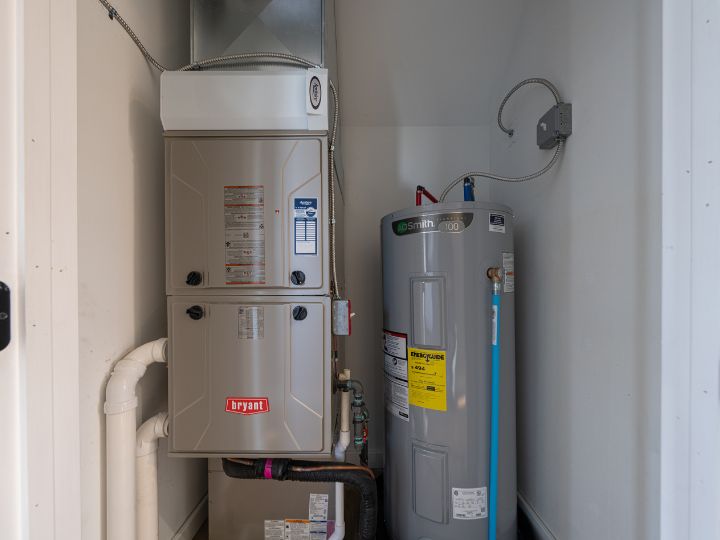
You’ve probably heard two things about heat pumps: they’ll slash your heating bill, and they quit when it’s 10 degrees out. Neither one is the full story. In Plymouth, Bristol, and Norfolk counties, whether a heat pump is a smart move comes down mostly to one question: what are you heating with right now? Maybe it’s an oil boiler in Pembroke, a gas furnace in Raynham, or electric baseboard in Dartmouth. Each of those gets a different answer. We install oil and gas systems as well as heat pumps, so we have no reason to push you in one direction. Here’s how it breaks down for homes across the South Shore and Southeastern Massachusetts.
Heat Pump Savings for Plymouth, Bristol, and Norfolk County Homes
A heat pump moves heat instead of burning fuel, which is why Carrier rates its efficiency at 300 to 500 percent, compared with about 98 percent at best for a gas furnace. That sounds like an easy win. The catch is that electricity in Massachusetts isn’t cheap, averaging about 23.94 cents per kilowatt-hour in 2024 and ranked as the fifth highest in the country.
So the savings depend on what you’re leaving behind. Rewiring America puts the average U.S. household’s savings at about $748 a year, and closer to $1,800 a year for households switching from fuel oil, propane, or electric resistance heat. Those are national averages, not a promise for your address, but they show where the real opportunity is.
Should I Switch From Oil to a Heat Pump in Southeastern Massachusetts?
Start with the homes that have the most to gain. Massachusetts has the highest share of oil-heated homes in the country—about 28 percent according to Nuwatt Energy—and plenty of older homes across the South Shore and Southeastern Massachusetts still run on oil. If that’s your house in Wareham, Marion, Pembroke, or anywhere in Plymouth County, you know the routine. Prices bounce around, the tank needs filling, and a typical 1,500-square-foot Massachusetts home burns roughly 800 gallons a season.
That’s where a heat pump has its strongest case. If you’re replacing oil, propane, or electric baseboard, you’re in the group Rewiring America says saves closer to $1,800 a year. Baseboard is the quiet winner. If you’re heating a house in Dartmouth or New Bedford with it, a heat pump does the same job on far less electricity.
We deliver heating oil ourselves, so we’re not rooting for your tank to disappear—and that’s exactly why you can trust us to say when switching makes sense. Plenty of homeowners start by adding a heat pump and keeping the boiler as backup for the coldest stretch, then decide later whether to retire it. If you do pull the tank, budget for decommissioning, which Nuwatt puts at $500 to $3,000. Ask about it up front so it doesn’t show up as a surprise on the invoice.
Will a Heat Pump Cost More to Run Than My Gas Furnace?
Possibly, and we’d rather tell you that now. Natural gas is cheap next to oil, and Massachusetts electricity isn’t. One Massachusetts homeowner published the math on his own house and found a heat pump would cost more to run than his gas system, even with generous subsidies. Your house could land differently, but his result isn’t unusual.
So if you have a gas furnace in good shape in Raynham, Randolph, or elsewhere in Norfolk County, swapping it only to save on fuel may not pay off. The better reasons look different: your furnace is near the end and you’re about to buy a central air system anyway, or you’re tired of hauling window units out every May. In those cases, one heat pump can replace both, and the rebate takes real money off the price.
Then there’s the cold question. Modern cold-climate heat pumps are built for Massachusetts winters, and Mass Save’s whole-home rebate requires cold-climate equipment. But how well one performs depends on how it’s sized and the design temperature for your house, and some homeowners keep a furnace as backup for the worst nights. That’s called a dual-fuel setup, and it’s a perfectly good answer. A right-sized heat pump with backup you trust is easier to live with than one asked to do everything on a bad January night.
What Changed With Massachusetts Heat Pump Rebates in 2026?
If you’ve been reading articles online, you’ve probably seen numbers that don’t match. That’s because the incentives shifted at the start of the year, and plenty of pages haven’t caught up. The federal heat pump tax credit of up to $2,000 ended for installations after December 31, 2025, and Mass Save’s whole-home rebate came down from the 2025 level.
There’s another wrinkle. The Massachusetts House passed a budget bill in February 2026 that would cut roughly $1 billion from Mass Save’s three-year budget, and the Senate hasn’t acted yet. Treat any rebate figure, ours included, as a snapshot, and confirm current amounts at masssave.com before you make a decision.
How Much Is the Mass Save Heat Pump Rebate, and Who Can Install It?
For 2026, the whole-home air-source heat pump rebate is $2,650 per ton, capped at $8,500. Last year it was $3,000 per ton with a $10,000 cap. A 4-ton system works out to $10,600 on paper, so it hits the $8,500 cap, and anything around 3.2 tons or larger gets there. The partial-home rebate pays $1,125 per ton, also up to $8,500, which suits homes that keep part of their existing system running.
There’s also a $500 sizing bonus when your system covers 90 to 120 percent of the heating load at the outdoor design temperature, and the load calculation has to be submitted with the application. A 0% HEAT Loan, advertised at up to $25,000, can help cover what’s left, and income-eligible households can qualify for more, up to $16,000 according to Nuwatt.
Two catches trip people up. Whole-home rebates require a free Mass Save Home Energy Assessment first, plus any weatherization it recommends, so build that into your timeline. And Mass Save requires the installer to be in its Heat Pump Installer Network. Ask every contractor you talk to whether they’re listed—we are—and ask to see the load calculation behind their sizing. Mass Save also suggests getting more than one quote, and we think that’s good advice.
Will a Heat Pump Fit My House? Ducts, Panels, and Coastal Weather in Bristol County
Most of what makes an install go well gets decided before anyone touches a wall. If you have ductwork and an air handler in decent shape, a ducted heat pump can often tie into them. If you don’t, or you heat with a boiler and radiators, ductless mini-splits serve individual rooms. Our installs cover sizing based on your square footage, insulation, and layout, along with the electrical connections, refrigerant lines, and any ductwork changes needed to work with what you already have. We protect your floors, test everything, haul away the old equipment, and walk you through how it runs.
Electrical panels are the other surprise. Some houses need an upgrade first, and when they do, we coordinate with qualified electricians rather than leaving you to sort it out. We also keep a record of every installation, so whoever comes back for service knows how your system was set up.
Coastal towns add one more thing to think about. Marion, Wareham, Onset, and Plymouth sit close to salt air, so where the outdoor unit goes and how it’s protected are fair questions for any installer. Mass Save suggests asking where the unit will mount, whether the line sets will be visible and insulated, and why a given indoor unit style is recommended. Ask how you’ll be kept in the loop on scheduling too, because that’s where plenty of homeowners say contractors let them down.
Once it’s in, our Dempsey Comfort Club gives you annual tune-ups and priority scheduling, and our NATE-certified technicians handle heat pump repair if something acts up.
Heat Pumps in Plymouth, Bristol, and Norfolk Counties: Where to Start
Here’s the short version. If you’re heating with oil, propane, or electric baseboard in Plymouth, Bristol, or Norfolk County, a heat pump deserves a serious look. If you’re on gas, the case is narrower and depends on whether your furnace and air conditioning are both due for replacement. Either way, the cold is manageable with proper sizing, the federal credit is gone, and Mass Save’s 2026 rebate is $2,650 per ton up to $8,500 for whole-home systems, so confirm the current numbers before you commit.
If you’re weighing this for your home in Marion, Dartmouth, Raynham, Randolph, Dover, or anywhere nearby, Dempsey Energy can look at what you have now, tell you honestly whether a heat pump, a new furnace, or a hybrid of the two fits, and explain the sizing so you can compare it against any other quote. Reach out to our North Attleboro team when you’re ready to talk it through.