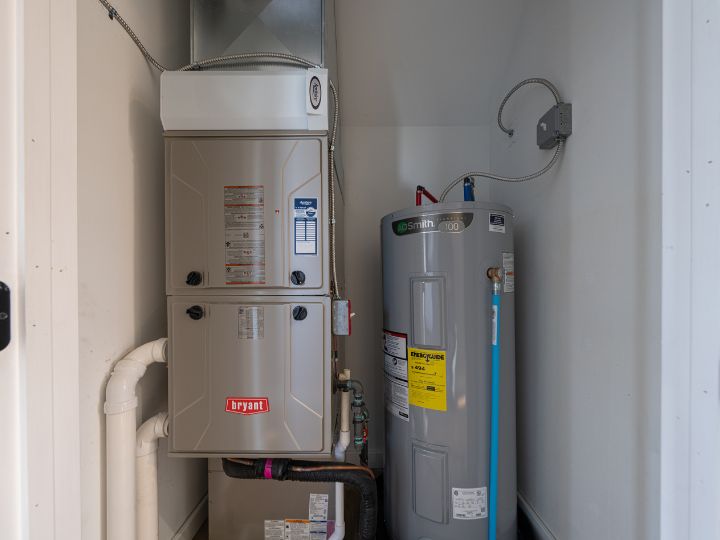
Your oil boiler is twenty years old and it’s making a noise it didn’t make last winter. Meanwhile, a neighbor in Norwell or Foxboro just mentioned they put in a heat pump, and now you can’t stop thinking about it. You’ve also heard that heat pumps don’t work in a real New England winter, and that they’re the only sensible choice left. Both claims are partly wrong. Modern heat pumps have changed a lot, but whether one fits depends on your house, your wiring, and what you heat with today. Here’s how we walk homeowners across Plymouth, Bristol, and Norfolk Counties through the decision, starting with why heat pumps suddenly seem to be everywhere.
Why Heat Pumps Are Outselling Furnaces—and Why Plymouth County Adoption Lags Behind
A heat pump doesn’t burn fuel to make heat. It moves heat from one place to another, pulling it from outdoor air into your house in winter and reversing the process in summer. One system heats and cools.
Nationally, heat pumps have outsold gas furnaces every year from 2022 through 2025, with roughly 3.6 million heat pumps shipped in 2025 against about 3.2 million gas furnaces. In September 2025 they even outsold central air conditioners for the first time.
Massachusetts is a different story. Only about 3.2% of households here use a heat pump, compared with roughly 16% across the country, and the state’s goal is 500,000 heat pumps by 2030. That means most homes in Plymouth, Bristol, and Norfolk Counties are still deciding. The technology is proven, but the advice varies widely—which is why the quality of guidance you get matters.
Do Heat Pumps Really Work When It’s 9°F in Plymouth County?
The cold-climate models do, and the “heat pumps can’t handle New England” line is mostly outdated. To qualify for Mass Save rebates, the equipment has to be ENERGY STAR Cold Climate certified and on the program’s qualified products list. Massachusetts owners have reported their systems handling a 9°F night without trouble, and some of them have no backup heat at all.
The caveat is sizing. A heat pump that’s too small for a drafty old Cape in Bristol County will struggle on the coldest nights, and one that’s too big cycles on and off and wears out sooner. That’s why a proper load calculation, called Manual J, matters. Mass Save says Massachusetts code requires it, and you should be wary of any quote that skips it.
Then there’s the question everyone asks next: will your electric bill jump? Yes, your electric use goes up, and Mass Save says so plainly. For many homes that increase is offset by burning less oil or propane. At average national prices, heat pump heat runs about 31% cheaper than heating oil and about 19% cheaper than propane.
Gas is a closer call, and a gas furnace is still cheaper to run in most states. If you’re heating with oil in Plymouth County, the math often leans toward a heat pump. If you’re on gas in Canton or Norwood, it deserves a more careful look. We’d rather tell you that up front than sell you the wrong system.
Can a Heat Pump Replace My Oil Boiler or Furnace?
It can, but you aren’t forced into all-or-nothing. Oil heat is still common across these counties, from older homes on the South Shore to Capes and ranches in Norfolk County, and the question we hear most is whether to switch completely or keep the old system around.
You really have three paths. You can replace like for like with a new boiler or furnace. You can go whole-home, where the heat pump carries the entire house. Or you can go partial, where the heat pump does most of the work and your existing oil or gas system stays as backup. The partial route needs integrated controls so the two systems cooperate, and Mass Save has a rebate tier built for it.
What you have now shapes the options. If you’ve got a furnace and sound ductwork, an indoor air handler can often connect to the ducts you already own. If you’ve got a boiler and no ducts, ductless mini-splits are usually the answer, and a mini-split is simply a heat pump without the ducts. Plenty of oil-heated homes across Bristol and Norfolk Counties also never had central air, so the heat pump handles the first July heat wave too.
We install and service oil burners, gas furnaces, boilers, air handlers, mini-splits, and heat pumps, so we have no reason to push you toward any one of them. If we already service your oil burner, ask us about it at your next visit.
What a Heat Pump Installation Looks Like in Older Plymouth, Bristol, and Norfolk County Homes
A good installation starts well before anyone carries equipment through your door. It begins with a visit to your house, a load calculation, a look at your electrical panel, and a decision about where the outdoor unit will sit. Mass Save also publishes a quality installation checklist for heat pumps, and it recommends asking any installer whether they follow it.
On install day, our crew sets the outdoor unit and the indoor air handler or mini-split heads, runs the refrigerant lines, handles the wiring, and calibrates the system. We protect your floors and furnishings and clean up when we’re done.
Before we leave, we walk you through the system and show you how it runs, then hand you written maintenance guidelines. We register your manufacturer warranty and enroll you in the Dempsey Comfort Club, which includes annual tune-ups and priority scheduling. The aftercare is a big part of why a heat pump keeps working well for years.
Will My Older Home Need a Panel Upgrade or New Ductwork?
Sometimes, and it’s worth knowing before you collect quotes. Whole-home systems usually want 200-amp electrical service, and across Norfolk County plenty of homes built before 1990 still have 100-amp panels. One regional contractor puts panel upgrades at $3,500 to $7,500 when they’re needed. We check your panel at the site visit rather than guess, because plenty of homes don’t need one, especially with a partial setup or a few mini-splits.
Ductwork is the other big variable. If the ducts in your Dedham colonial or Foxboro ranch are in decent shape, an air handler can often tie into them. If they’re undersized, leaky, or nonexistent, as in many older triple-deckers and oil-heated homes across Plymouth County, ductless heads may make more sense. People worry about ugly units on every wall, and fair enough. Placement matters, and a good installer talks it through with you instead of drilling wherever is easiest.
Then there’s the outdoor unit. It needs clearance from snow and drifting, and it needs a spot where the condensate drain makes sense. That drain is a plumbing detail, and it’s one reason it helps to have one company that handles heating, plumbing, and electrical. If you’re also thinking about a heat pump water heater down the road, that’s an add-on we can talk through at the same visit.
What Are the 2026 Mass Save Heat Pump Rebates?
The old $10,000 whole-home rebate has been retired, though plenty of contractor websites still advertise it. For 2026, Mass Save pays $2,650 per ton for a whole-home system, capped at $8,500. A partial-home system earns $1,125 per ton, also capped at $8,500, and it requires integrated controls or a zone that’s fully offset. Bonuses of $500 for sizing and $500 for weatherization can raise the standard maximum to about $9,500. Income-qualified households can get up to $16,000, and the 0% Mass Save HEAT Loan covers up to $25,000.
The federal tax credit of up to $2,000 ended for systems installed after December 31, 2025, so don’t count on it. Rules and amounts change, so check masssave.com before you plan around any number, including ours.
Your eligibility also depends on your utility. Eversource and National Grid both serve Plymouth, Bristol, and Norfolk Counties, and municipal utilities have their own rules. Beyond that, the equipment has to be on Mass Save’s qualified list, and incomplete paperwork is a real way to lose rebate money. We walk you through eligibility before any work begins. It’s also smart to look up any installer on Mass Save’s installer finder before you sign, ours included.
Is a Heat Pump Right for Your Home? Talk It Through with Dempsey Energy
Heat pumps are proven, they’re growing fast, and they’re still new enough in Massachusetts that the advice you get varies a lot. Whether one makes sense comes down to the fuel you’re using now, the size and condition of your home, your electrical panel, and which rebates you qualify for. Cold-climate models handle our winters, but only when they’re sized properly. A partial system with your existing boiler or furnace as backup is a legitimate choice.
Dempsey Energy is family-owned, based in North Attleborough, and rooted in the South Shore. We install heat pumps from Raynham to Acushnet and service oil and gas systems from Plymouth to Dedham. We also offer a written 10-year labor warranty on select new HVAC installs, so ask whether your system qualifies. If your boiler is on its last winter or your AC just quit, reach out to Dempsey Energy and we’ll help you sort out the options without pressure.